
Icosa Computing
Local AI that learns the work.
Everything you love about your AI assistant, without usage limits or bills that grow out of control. Icosa runs on your computer, not in the cloud.
- No token costs. Use it as much as you want.
- Super fast. Answers instantly, right on your device.
- Private. Your files never leave your computer.
Partners & Supporters







Products
Zeno: Local Work
macOSThe local AI workspace that learns your work. Zeno adapts to your documents, code, and terminology, entirely on your machine, with no model selection or setup.
Download Zeno for MacLaunched August 19, 2026
- 35B-parameter model on your MacBook
- Generates 20-50 tokens/sec locally
- $0 per token, works fully offline
LMShop
WebThe ultimate garage for your own AI models. Bring your documents, build a custom model, tune it, and race it against the frontier. Drive it out and run it anywhere you like, or straight inside Zeno.
Use LMShopHow it works
- 1. Upload your docs
- 2. Train with no code, in minutes
- 3. Download & run locally
Your hardware does the compute.
Usage never adds a bill.
01
Zero token costs
Agentic work turns one request into many model calls. On rented AI, that compounds a bill. On Icosa, it costs nothing.
02
Private by design
Files, prompts, and model weights never leave machines you control. No cloud dependency and no vendor shutdowns.
03
Expert accuracy
Combinatorial Reasoning scores many answer paths and selects the strongest, closing the gap with hosted frontier models.
Research
Many reasoning paths. One better answer.
Combinatorial Reasoning is a physics-based optimization method developed with NASA and funded by the National Science Foundation. It samples many reasoning traces, scores them, and selects the strongest set before answering, so small local models perform like much larger ones on the work they know.
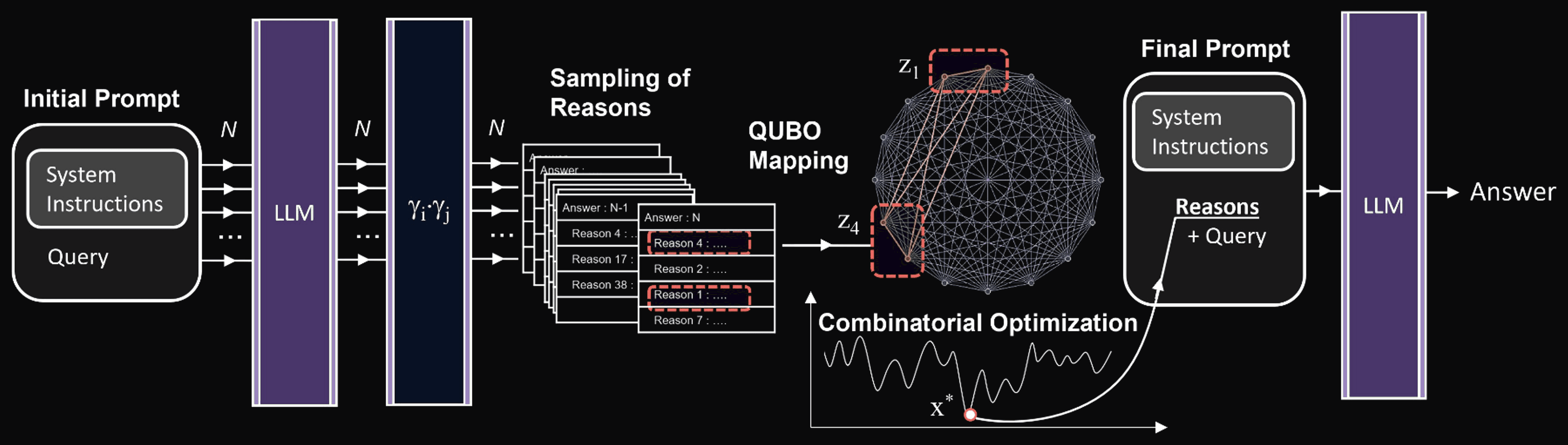
Esencan et al., arXiv:2407.00071
Team
Deep-tech researchers, shipping product.
Tarun Advaith
Research
Waterloo PhD. Drives Icosa research; author of ML and quantum papers.
FAQ
Frequently asked questions
Local AI, private and secure AI, on-prem deployment, data sovereignty, small language models, and how Combinatorial Reasoning works.
Combinatorial Reasoning is Icosa's physics-based optimization method, developed with NASA and USRA and supported by $1.4 million in funding from the U.S. National Science Foundation. Instead of accepting a model's first chain of thought, it samples many candidate reasoning paths, scores them, and selects the strongest subset. Icosa uses it when building and tuning models, so that small local models reach reasoning quality normally associated with much larger hosted systems.
Zeno is Icosa's local AI workspace for macOS, released August 19, 2026. It learns your documents, code, and terminology on your machine, with nothing to configure and no model selection to manage. All you need is an Apple Silicon Mac; download it at icosa.co/zeno.
Zeno fits a 35B-parameter model inside a Mac app and makes it act like a much larger system. The model ships in the download, and the workspace around it handles files, documents, and long agent tasks safely, entirely on your machine. Combinatorial Reasoning is one of the training methods behind Icosa's models; the product innovation is Zeno itself: a frontier-style AI workspace that runs and stays entirely on your laptop.
On Apple Silicon, Zeno typically generates 20-50 tokens per second, depending on your Mac's memory and what else is running. Because inference is local, there is no rate limit and no queue, and heavy use costs nothing beyond electricity.
When the model runs entirely on your own hardware, yes. There is no API call, so nothing is transmitted anywhere. With Icosa, your prompts, documents, and the model weights themselves stay on machines you control, which means no third party ever receives your data in the first place.
Anything you type or upload passes through servers you do not control. That data can be retained, logged, reviewed by staff, or used to train future models, depending on the provider's terms. It can also be exposed in a breach, and shared conversation links have been indexed by search engines. Beyond privacy, the vendor can change pricing, restrict access, or shut a model down without notice.
It depends entirely on where inference happens. With cloud AI, your data sits inside someone else's system under their retention and access policies. With local AI, you keep custody: your compliance team can audit exactly where data lives, there is no third-party processor to vet, and there is no cloud breach that can expose your files.
Data sovereignty is the principle that data is subject to the laws of the country where it is stored and processed. Cloud AI can move your data across borders and into jurisdictions with different rules, which creates real problems under regimes like GDPR. Running models on your own infrastructure keeps data physically inside your jurisdiction and under your own governance.
On-prem (on-premises) AI is AI deployed inside your own infrastructure, such as a workstation, an office server, or your own data center, rather than rented from a cloud provider. Icosa specializes in on-prem AI for regulated firms: small, domain-expert models that run on a few GPUs or even a MacBook, instead of frontier-scale models that need a 1.5 TB cluster.
Open-weight models are models whose trained parameters are published for anyone to download, so you can run them, fine-tune them, and inspect them on your own hardware. They now catch frontier releases within weeks. Icosa turns open-weight models into domain experts for your specific work, so you get frontier-level results without depending on any single vendor.
Icosa removes the cloud from the loop at every stage. LMShop trains a custom model from your own documents, and you download that model and own it outright. Zeno then runs it on your Mac, entirely offline. Combinatorial Reasoning keeps the quality high enough that going private costs you nothing in capability.
An SLM is a language model compact enough to run on local hardware, typically billions of parameters instead of trillions. A general frontier model spends most of its capacity on knowledge your team never uses. An SLM fine-tuned on your domain matches frontier output on the work that matters, while being faster, cheaper, and fully private.
The inference is. Cloud AI charges per token, so heavy use means growing bills. With local AI, your computer does the work, so usage costs nothing beyond electricity. An agent can run thousands of steps overnight for pennies, with no subscription scaling against you, no token meter, and no rate limits.
No. The model ships inside the app, so inference happens on your Mac and Zeno keeps working with Wi-Fi off. You only need a connection for the initial download and for optional updates. That is also the privacy guarantee: nothing can leave a machine that is not transmitting.
AI shouldn't be rented by the token.
Bring owned, private AI to your team, on the hardware you already have.