
Open-Source Models Are Catching the Frontier. Icosa Closes What's Left of the Gap.
Open-weight models now catch the frontier in weeks. Icosa gives regulated firms the same performance from far smaller domain-expert models, using fine-tuning and Combinatorial Reasoning.
Written by: Baran Melik
Published: July 21, 2026
Open-source models keep catching the frontier
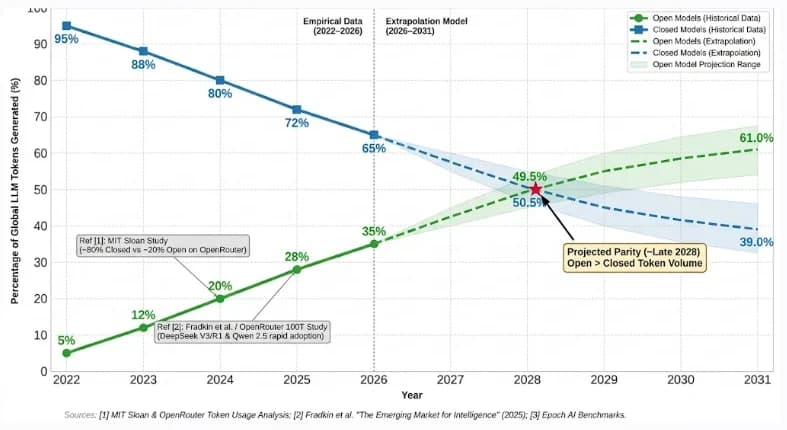
The main difference between a frontier model and an open-source one used to be performance. Now it's just time, and even that is shrinking. GPT-4 arrived in March 2023, and it took Meta 16 months to match it with the open-weight Llama 3.1 405B. GPT-4o followed in May 2024, and DeepSeek-V3 caught it seven months later. The gap kept narrowing: when OpenAI released o1 in September 2024, DeepSeek-R1 matched it just four months on.
These aren't exceptions, they're the pattern. Epoch AI's May 2026 study found that the best open-weight models lag closed frontier models by four months on average, or 8 points on the Epoch Capabilities Index (ECI). For reference, 8 points is the difference between GPT-5 and GPT-5.5.
The frontier fought back with compute
The frontier labs didn't stand still, though. Flush with funding, they widened their compute advantage over the open-source labs, and the gap Epoch once measured at three months stretched back to four. Anthropic's Fable looked like the moment the narrative swung back to the frontier for good. It was one of the most capable models anyone had seen, and the odds of an open model catching it seemed vanishingly slim.
Kimi K3 caught Fable 5 in five weeks
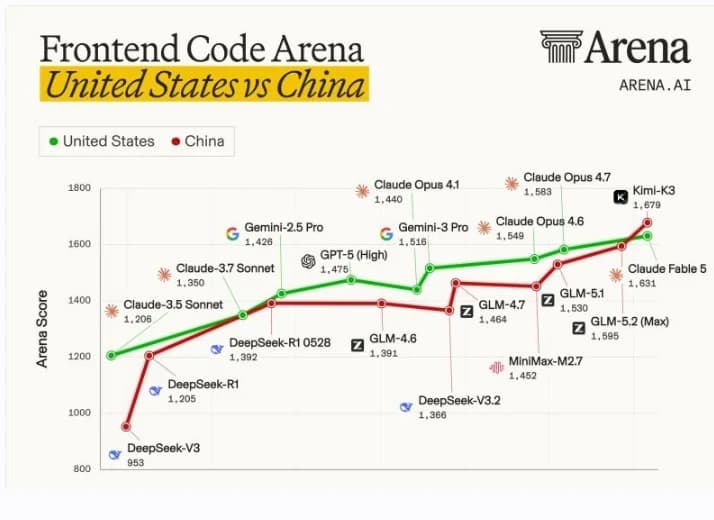
That held until Kimi K3, released just five weeks after Fable 5. Moonshot AI shipped the model on July 16 and will publish the open weights on the 27th. K3 matches Fable 5 on most tasks, slips slightly behind on some, and beats it outright on others, according to both Moonshot's and independent benchmarks. On Artificial Analysis it posts an overall Elo of 1,547, second only to Fable 5, and on Arena's blind Frontend Code evaluation it ranks first, ahead of Fable 5. It also beats Opus 4.8, which launched on May 28.
Open-weight models still aren't easy to self-host
For Icosa's core partners, the regulated firms in finance, there's still a wait. K3 is API-only for now, priced at roughly half of Anthropic's Opus 4.8, with the full open weights due July 27 under a Modified MIT license.
Even then, self-hosting an open-weight model this size is no small feat. K3 needs roughly 1.5 TB of memory, which means a serious on-prem GPU cluster and the engineering team to run it. That footprint is a fit for the billion-dollar enterprise that can absorb the capital and staffing, and where the volume justifies owning the hardware outright. For everyone else, it's the wrong tool. A mid-sized hedge fund or a regional bank does not need a 2.8-trillion-parameter general model, and cannot justify the cluster to host one.
How Icosa delivers frontier performance from domain-expert models
That's where Icosa comes in. Icosa gives firms in regulated industries frontier-model performance from smaller, domain-expert open models. We get there with three things: our proprietary Combinatorial Reasoning engine, distillation, and fine-tuning tuned to each firm's specific tasks. A frontier-scale model spends most of its parameters on general knowledge your desk never touches. A domain-expert model, fine-tuned on your data and sharpened with Combinatorial Reasoning, matches that output on the work that actually matters, which means full AI enablement inside your walls on just a few GPUs.
Icosa's automated optimization platform then lets you deploy every new open-weight model as it lands, in a few clicks, so you're never locked to one lab or waiting on one vendor.
The catch-up window is no longer a reason to wait
The catch-up window between open-source and frontier models used to be the reason to delay going on-prem. Now that window has shrunk to weeks, and Icosa closes what's left of it with domain-expert models, fine-tuning, and Combinatorial Reasoning.
Note: As I finished this piece, Alibaba previewed Qwen 3.8, a 2.4-trillion-parameter model the company says trails only Fable 5. Open weights are promised but not yet dated. It repeats the same pattern within the same week: another large open model chasing the frontier.
Sources
Public model release dates; Meta and DeepSeek technical reports (MMLU, MATH, coding); Epoch AI, “Open models lag state-of-the-art closed models by 4 months” (May 2026); Artificial Analysis and Arena independent K3 evaluations; Moonshot AI's K3 launch materials; Alibaba's Qwen 3.8 preview announcement (WAIC, July 19, 2026).